A free guide
How to lay out a musallah
Most prayer spaces I am asked to fix are already beautiful. The sequence is just wrong. These are the five decisions that make one work, in the order they should happen.
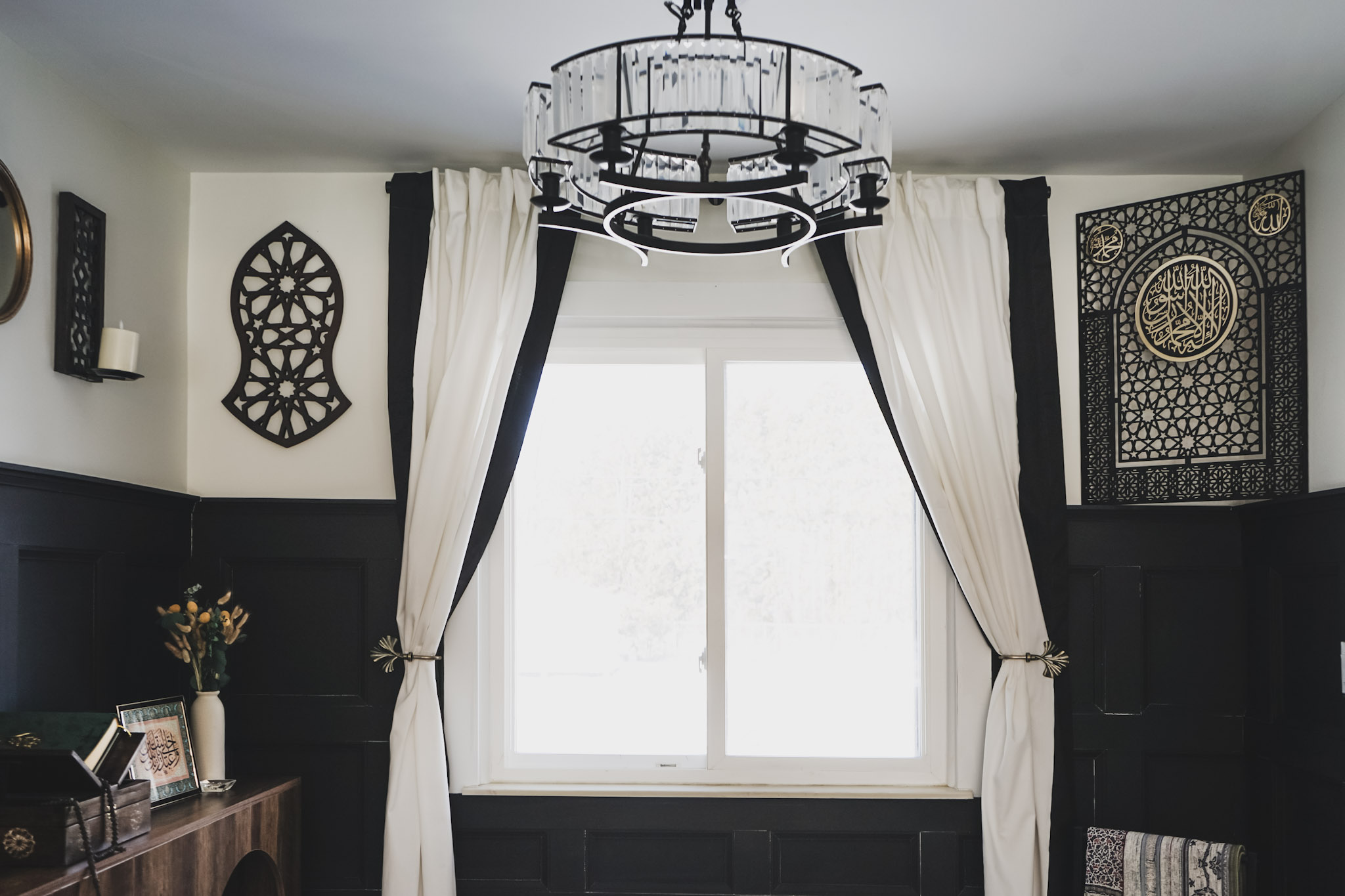
A family in Troy prayed for six years on a rug rolled out between toy cars. The room was not unfinished. It had simply never been asked what it was for.
What follows is the order we worked in on that project, and the order I work in on every prayer space since. It applies to a dedicated room and to a four-foot corner equally — the corner is the more common case, and the more interesting one.
1
Direction before furniture
Find qibla first, standing in the room, with a compass in your hand. Not after the console is bought. Not after the rug is down. Everything else in the space is arranged in relation to that one line, so it is the only decision that cannot be reversed cheaply.
Stand where you would pray and look at what is in front of you. A radiator, a doorway that opens inward, a television — each of those is a reason to move a few feet along the wall before anything is fixed in place.
On precision: how much deviation is acceptable is a question of religious guidance, not interior design. Ask your imam or a scholar you trust. My work starts once you know the direction; it does not extend to ruling on it.
The floor is the furniture
In most rooms the floor is what is left over after the furniture. In a musallah it is the primary surface, and it has to stay clear.
Allow 30 inches wide by 54 inches deep per person praying — a standing frame plus room to go down into sujud without reaching the wall. Add a further 12 inches of clearance in front, so nothing is ever touched on the way down. If more than one person prays at once, rows need the same 54 inches each, back to front.
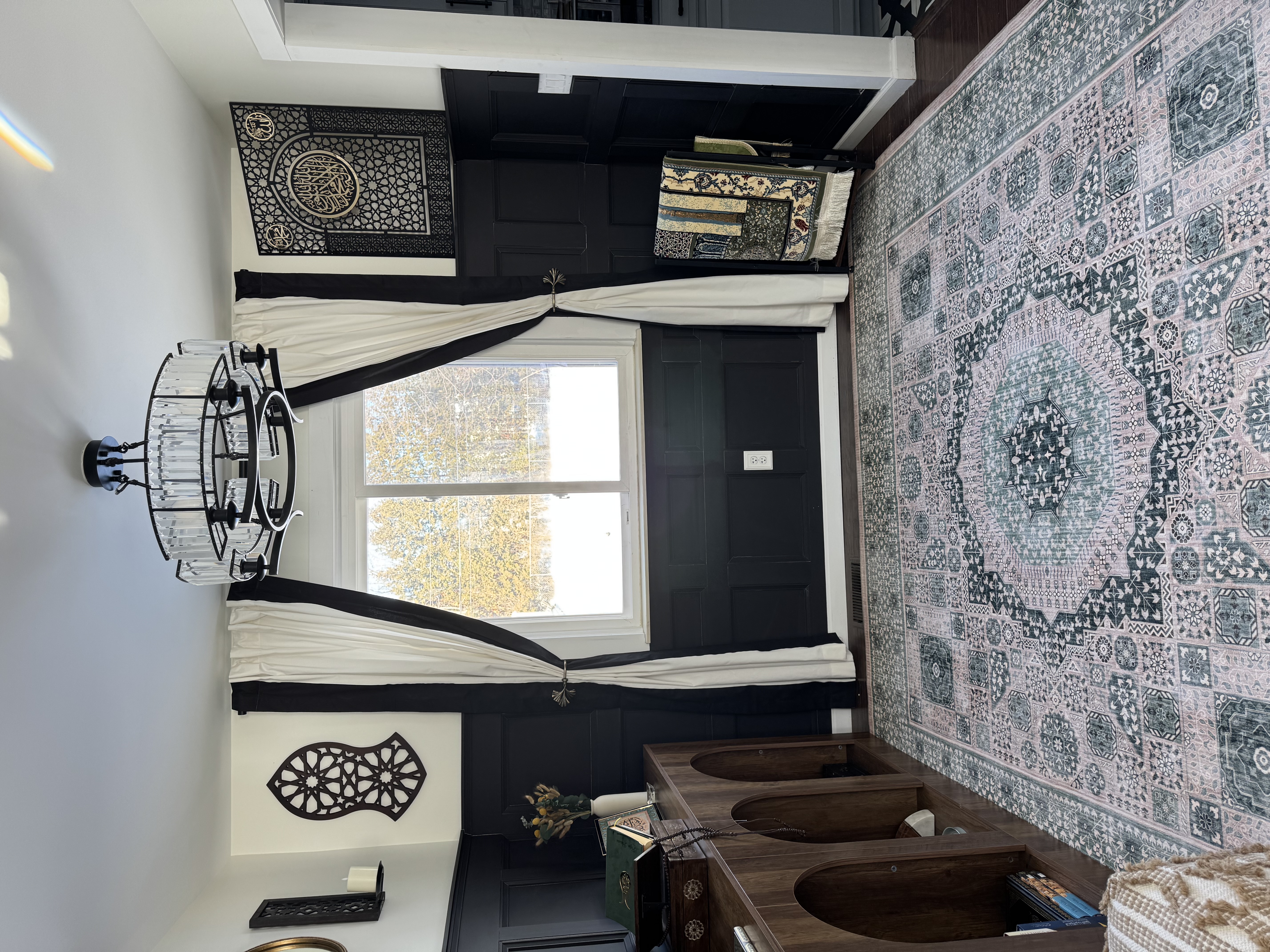
Practical consequences: no coffee table that has to be moved, no floor lamp with a base in the path, and a rug that either stays permanently or rolls up in one motion. Underlay matters more than pile height — a thin, dense rug over a firm pad is kinder to knees than a thick soft one.
Storage within arm's reach
A prayer space fails quietly. Not because it is ugly, but because the Qur'an ends up stacked under something else and the tasbih is in a drawer in another room.
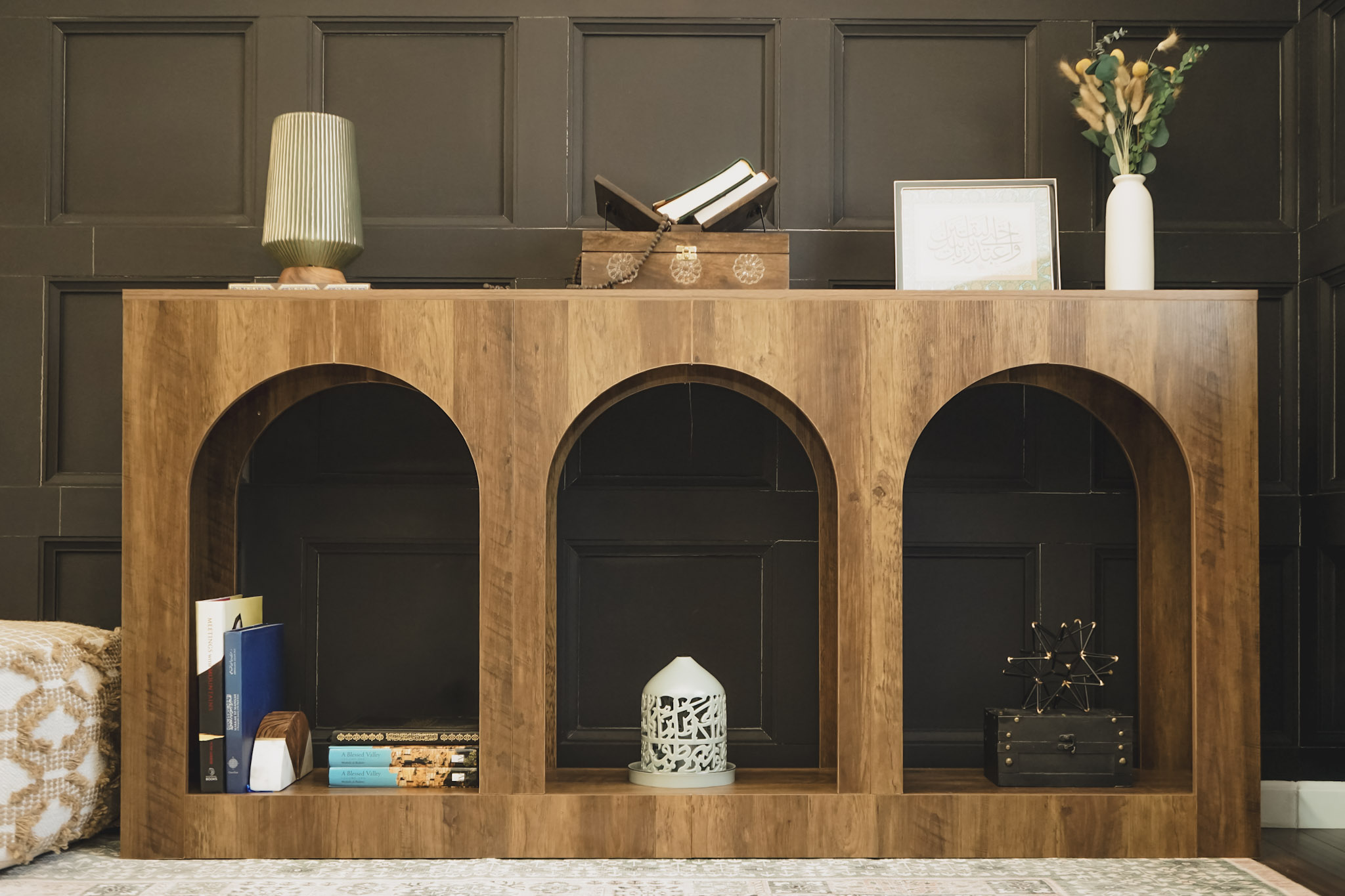
Everything used in prayer should be reachable without standing up and walking: the Qur'an, a rehl or stand, prayer beads, a spare prayer garment, an extra rug for a guest. A console 54 inches wide by 14 inches deep holds all of it against a wall and still leaves the floor open — shallow is the whole point. Deeper than about 16 inches and it becomes a surface things get piled on.
Give the Qur'an a stand rather than a shelf. A book that lives open gets read; a book that lives in a stack does not. That is a design decision about behaviour, not about looks.
Light you can lower
Prayer happens before dawn and after dark. A single bright ceiling fixture is the wrong instrument for both.
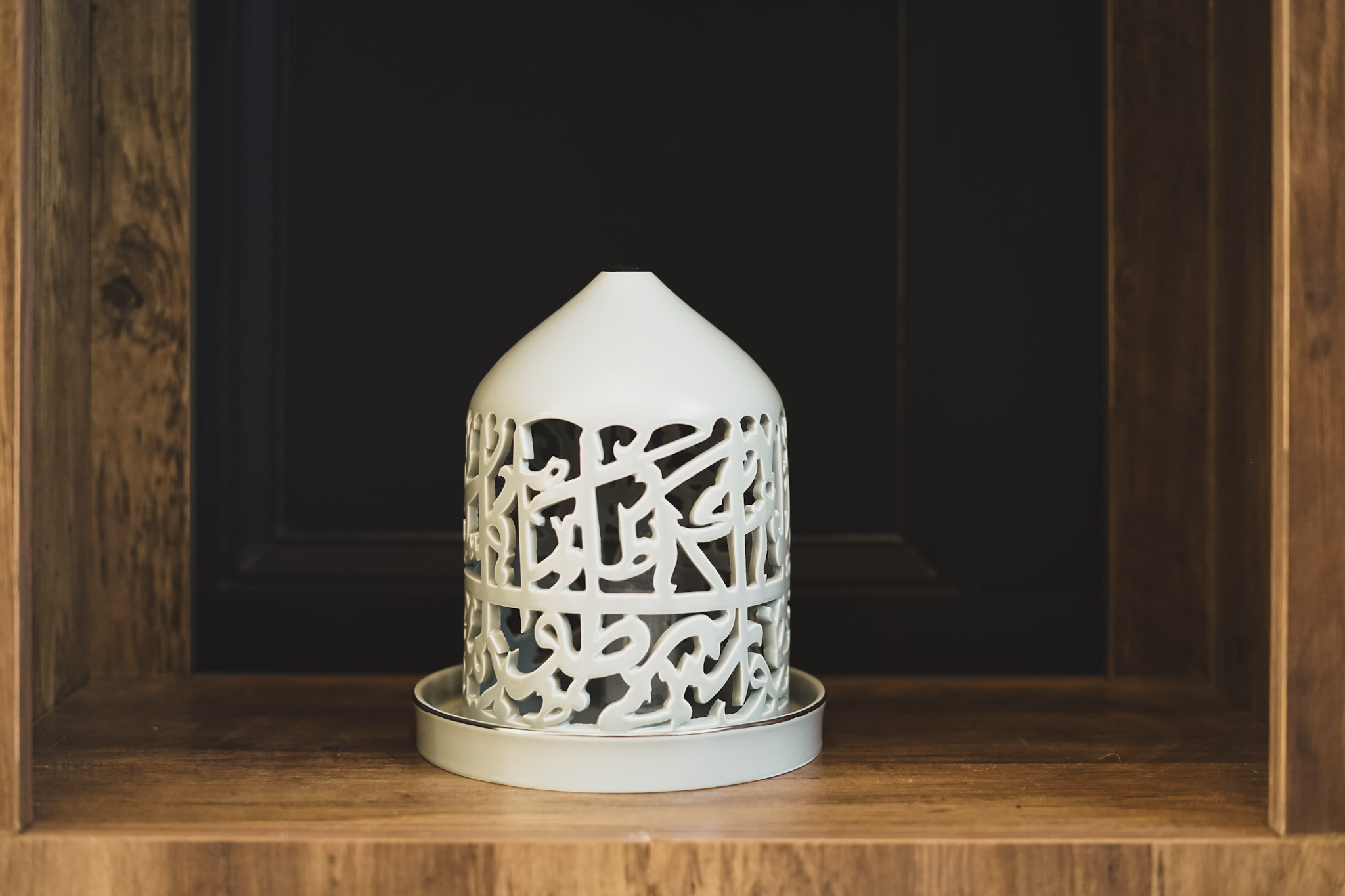
The workable minimum is two sources on separate switches: something overhead for cleaning and setting up, and something low and warm — a wall sconce, a small lamp on the console — for the prayer itself. A dimmer on the overhead is the cheapest upgrade in the entire room.
| Element | Height | Why |
|---|---|---|
| Wall sconce | 60–66 in to centre | Above a standing eye line, below the ceiling glare |
| Pendant or fixture | 7 ft 0 in to the lowest point | Walk under it without ducking |
| Bulbs | 2700K, CRI 90+ | Warm, and honest about the colour of wood and paper |
Avoid anything that throws light directly into the eyes of someone standing. Light aimed at a wall or a ceiling comes back into the room softened, which is what you want.
A threshold, however small
The last decision is the one people skip, and it is the one that makes the space feel like a space rather than a patch of floor.
A threshold is any signal that you are entering somewhere different. It can be architectural — an arch, a niche, a change of ceiling. Far more often it is modest: a rug with a defined border, a curtain that can be drawn, a screen, a change in flooring, two panels of drapery framing the wall. In a shared living room, one is essential. Without it, the prayer space is simply the part of the room nobody sits in.
Test it by walking in. If your attention changes at a particular point on the floor, the threshold is working.
A weekend version
If you are setting up a corner this weekend and buying nothing custom, do it in this order.
- Find qibla standing in the room, and mark the direction on the floor with tape.
- Clear a 30 x 54 in footprint plus 12 in in front. Move what is in the way permanently, not temporarily.
- Lay a firm rug with a defined border, over a pad.
- Put a shallow surface against the wall — a bench, a narrow console, a low shelf.
- Bring the Qur'an, a stand, and the tasbih into arm's reach. Nothing else.
- Add one warm, low light on its own switch.
- Define the edge: a curtain, a screen, or the border of the rug.
- Pray in it once, then change one thing. There will be one.
The measurements in one line: 30 x 54 in per person · 12 in clearance in front · console 54 x 14 in · sconce 60–66 in to centre · fixtures no lower than 7 ft · bulbs 2700K, CRI 90+.
Planning one of your own?
I design prayer spaces as part of a whole room — in Metro Detroit in person, and anywhere else virtually. Tell me about the room and I will come back to you personally.
Start your project inquiry Or use the form on illumedesignmi.com